
TOC Graphic Design for Journal Submissions
A TOC graphic presents the paper at a directory-view scale. Start with the target journal’s requirements and one supported message, then compose specifically for that use.
Establish the submission category
Record the journal, article type, submission stage and whether the requested item is a TOC graphic, graphical abstract or another image category. Names alone do not establish identical dimensions or text rules. Keep a copy of the actual instructions used for the project.
Select what survives reduction
Choose one principal object, relationship or process. Remove controls and secondary pathways that belong in the main paper. Check the actual target display size; enlarging the working canvas can conceal unreadable labels.
Use a real interface example carefully
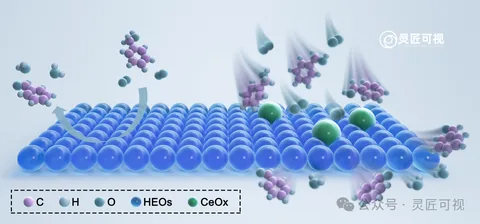
The cerium-doped catalytic-interface illustration separates the substrate, selected sites, molecules and directional arrows. It can inform object hierarchy, but adapting it to a TOC submission requires a fresh composition and the relevant permissions.
Agree what the commission includes
Confirm concept options, drawing scope, final dimensions, file formats, caption or text needs and revision limits. Review the TOC tutorial, compare graphical abstract design and prepare a scoped inquiry.
Choose the next step
Understand the platform · Scope a design commission · Contact support